
When I started trying to play jazz, I had really no idea what I was doing. I had only been
playing guitar for 2 or 3 years, knew some blues licks, had a vague idea of scales, chords and
how they worked together harmonically, could barely read music and had limited technique.
However, I loved jazz and the idea of improvising really appealed to me. Making stuff up in the
moment seemed like fun a great way to express yourself creatively. I learned really fast that
improvising was not just “making things up” and that you had to KNOW what you were playing
or else it was going to sound really bad.
The purpose of this blog is to give you just a small idea of what it takes to begin playing jazz
and improvising correctly. It deals more so with basic fundamentals that we all encounter at
some point or another as a guitar player, depending on how far we want to go and what we
want to learn. Because the main ingredient in jazz is soloing or improvising, a lot of this
material is technique, single-note based. But as guitar players, we also have to be able to
accompany or “comp” behind a soloist so chordal knowledge is essential. Basically it boils
down to this, if you want to go down the jazz rabbit hole, then first be prepared with the
following.
1. Know your scales.
One of the first technical things we learn as guitar players is a scale, usually the minor
pentatonic one, which is used so heavily in blues and classic to newer rock. The pentatonic
scales which are five notes, ALL come from either the major or relative minor scale, which are
eight notes. Every scale comes from the chromatic scale which includes all twelve tones in
music.
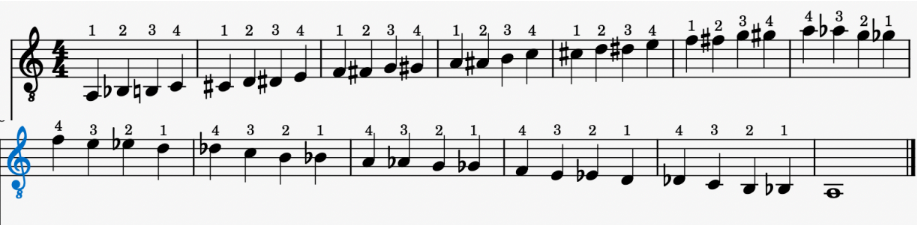
If you learn your major scales you will end up also knowing your modes (the major scale itself is
referred to as the Ionian Mode), which are based of the major scale, and figure heavily into
improvising, especially in what we call “modal jazz”, where the chord progressions are static or
have two to three chords. If you are a fan of jam band music then you have heard modal
improvisation before even if you have never listened to jazz because lots of jam bands like to
improvise around one or two tonal centers.
To improvise well, knowing your scales in all twelve keys, all over the fretboard is essential.
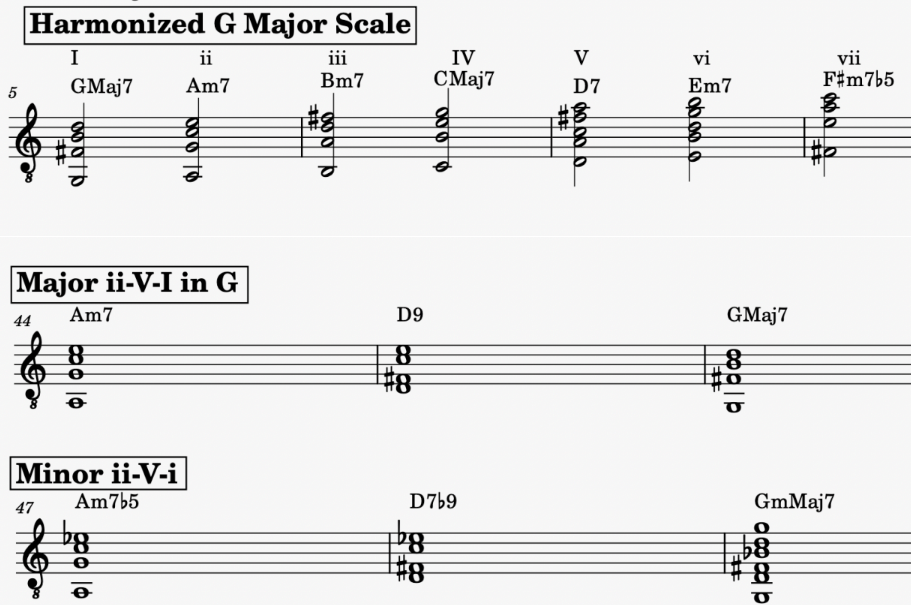
There is no shortcut. Furthermore, knowing how to harmonize your scales, with chords is
another essential element to playing jazz. Being able to recognize a ii-V-I progression (major
and minor) and the key that it is in is another thing to be aware of because ALL standard jazz
tunes have them and the first tunes you learn to play are standards.
Also when I say “know your scales”, I mean really know your scales. Can you play in any key
on any string, from any starting pitch? Can you play the scales in different intervals: 2nds, 3rds,
4ths, 5ths, 6ths, 7ths? Can you stack them in different intervals?

2. Know your arpeggios and four basic triads: Major, Minor, Diminished, Augmented
An arpeggio is when you play the notes within that chord individually, rather than strumming
them as one unit. Some of the first arpeggios we play on guitar are usually when we learn a
song that requires either some fingerpicking (like “Dust in the Wind”) or individually picked
chords (the beginning of “Stairway to Heaven”). In the world of classical guitar there are
thousands of etudes based on just arpeggios, usually played in open position but not always.
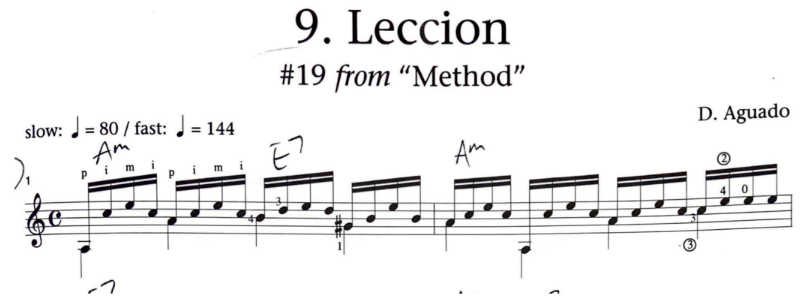
An excerpt from a classical guitar arpeggio etude based around open chords
An arpeggio can be played starting from the root, or from another note of the chord, which is
called an inversion. Learning to play them on the guitar, across the strings and fingerboard, is
another technical element that we may come across at some point depending on how far we
want to go as players. A jazz player should know all their arpeggios: Major, minor, diminished,
augmented to start with and then continue on with 7ths, 9ths, 13ths, etc. Once you get past
basic triads, all extended chords are triads stacked on top of each other.
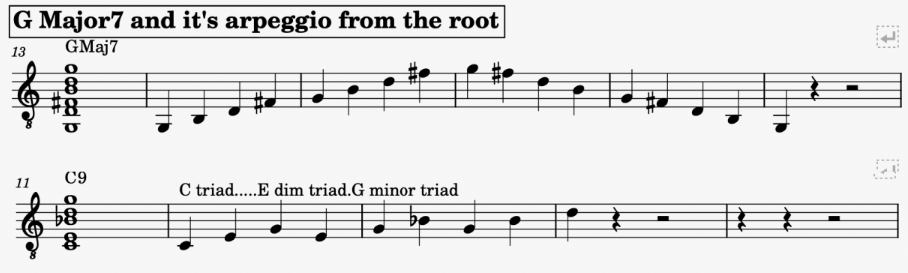
For example, a C9 chord, which is spelled: C-E-G-Bb-D is made up of three individual triads: C
major: C-E-G; E diminished: E-G-Bb; G minor: G-Bb-D. When improvising, knowing how to see
a chord on the fretboard from any note of that chord is something that a jazz guitar player
should be aware of.
3. Know your 7th barre chords
Outside of modal jazz, which has 2 or 3 chords, standard jazz has a lot of chords. Usually two
to a bar and oftentimes modulating to different keys. Knowing how to play all your 7th chords:
Major, Minor, Dominant, Diminished, Augmented preferably in twelve keys in at least 2 or 3
different voicings: both barre and shell, is another key factor to playing jazz guitar. While
soloing is a big part of playing a jazz tune, we as guitar players often times spend more time
supporting a soloist rather than being one. You can also create great solos using just chords
too. Wes Montgomery in addition to revolutionizing the use of octaves in a jazz solo, was also a
master of chord solos.

4. Know the blues!
The blues is ingrained in jazz with over thousands of jazz blues tunes to play. However, unlike
the typical 12-bar blues that we learn as guitar players that revolves around the I,IV and V
chord a jazz blues will have more harmonic movement using ii-Vs within the twelve bar format.
The blues scale will work over a jazz blues for the most part but knowing how to navigate the
other changes that lead to the IV and V chords is something that we need to know.
Notice in the progression below, the use of ii-V (Dm7-G7) to get to the IV chord (C7) and the I-
iii7-vi7-ii7-V7 starting at bar eight.

5.Know how to listen to your bandmates.
Listening to one another in jazz is crucial. While it may seem like there is just a soloist and his/
her accompanists, there is a lot more going on in the moment when a jazz group is playing.
While the soloist may be leading the group, if their bandmates are listening to them they may
be feeding them ideas, both rhythmic and harmonic in order to get them to take their solo in
another direction. There is a lot of give and take that goes on within the context of a jazz solo
between the improviser and their bandmates and this is skill is something that can only be
honed by playing as much as possible. Likewise, if we as guitar players are comping for a
soloist, giving them a firm foundation on which to build their solo is necessary for them to
succeed with their musical story.
Conclusion:
Of course this is just the tip of the iceberg. Like anything else, playing jazz also means listening to it, A LOT. You can’t learn how to play it out of a book but instead have to go to the source itself: the thousands of jazz recordings that are available to listen to and the learn the language.
The scales, arpeggios, etc are just tools that are used in creating the language that we call jazz, the ingredients needed but not necessary the main dish. Transcribing lines of their favorite players is how many musicians came to learn the language and it’s still the best way to learn. You build your ear as well your technical and melodic skill just by taking a four or eight bar phrase, analyzing it and seeing how it fits in to a harmonic setting.
As a guitar players there are hundreds of master jazz guitarists to expose our ears to but we must also listen to all the other instrumentalists, like the horn and piano players because they are the majority of jazz musicians that are currently in the canon.
All the jazz guitar players from today and yesterday listened to the great horn and piano players and there is an old cliche that just about every jazz guitar player will mention at some point or another “I didn’t listen to as many guitar players as I did horn players”. The reason for this being that if you learn a horn line on the guitar it will test your technical ability because a horn player can play certain intervals that don’t necessarily lay well on the guitar fretboard or fall into a specific shape or pattern. Some horn lines do lay well on the guitar while others do not and the same can be said for any non-guitar instrument and the music written for it. More than anything being a successful jazz musician and really a successful improvising musician, means knowing how to use your ears to make your musical ideas come to life on the guitar. By having a firm grip on the five topics above you may just be on your way.
If you want to go deeper, here a few books that I found useful for me when I was just getting
started:
- Improvising Jazz by Jerry Coker. An essential jazz primer. Jerry Coker is one of the premier
jazz educators - The Jazz Theory Book by Mark Levine
- The Charlie Parker Omnibook – great for sight reading as well as plethora of bebop lines and
tunes. If you are not familiar with Charlie Parker or Louis Armstrong for that matter, then you
need to be. Armstrong was the first major improvising jazz musician and Parker essentially
created the language of bebop and modern jazz that is still being used today.
A few jazz guitar method books:
- Chords Galore by Jack Petersen (This is a required book for all my jazz guitar students and
one I wish I had known about when I first started playing). - The Guitarist’s Introduction to Jazz
- Three Note Voicings and Beyond
- The Cellular Approach by Randy Vincent
- Jazz Guitar Structures
- Jazz Guitar Technique – Andrew Green
Some jazz guitarists to consider would be: Charlie Christian, Wes Montgomery, Jim Hall, Kenny
Burrell, Grant Green, Jimmy Raney, Pat Martino, John McLaughlin, Pat Metheny, John Scofield,
Bill Frisell, Mike Stern, John Abercrombie, Kurt Rosenwinkel, Mike Moreno, Gilad Hekselman,
Adam Rogers, Ben Monder, Nir Felder, Peter Bernstein